
Commercial Mortgages: A Guide for UK Business Owners
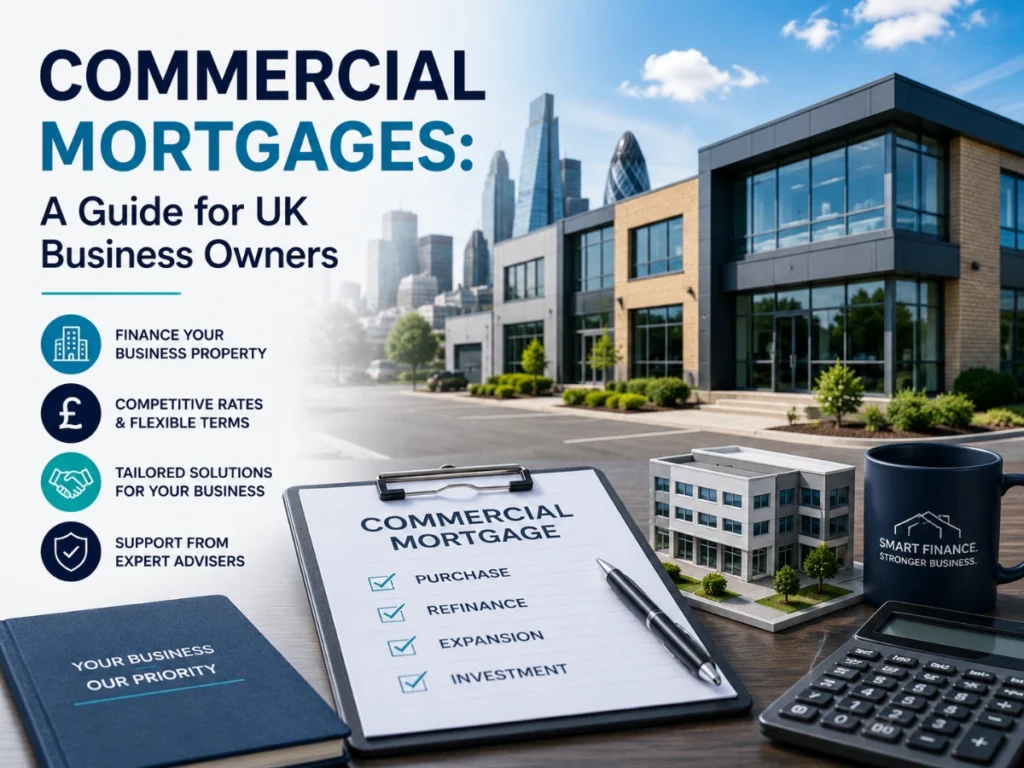
A commercial mortgage UK lenders provide is a loan secured against a business property, used to purchase or refinance premises such as offices, retail units, warehouses, or investment property. Most lenders require a deposit of 25% to 40%, with rates in 2026 typically ranging from 5.5% to 9.5% depending on the loan-to-value, property type, and strength of the business. Unlike a standard mortgage, pricing is bespoke and assessed case by case, which is why FairBridge Finance works across a whole-of-market panel of commercial mortgage lenders to find terms suited to each business’s specific circumstances.
Key Takeaways
- What it is: A loan secured against commercial or semi-commercial property, used for either owner-occupation or investment purposes.
- Deposit: Typically 25% to 40% of the property value, meaning most lenders cap borrowing at 60% to 75% loan-to-value (LTV), occasionally up to 80% for strong cases.
- Rates: Currently range from around 5.5% to 9.5% for fixed products, or a margin over the Bank of England base rate for variable deals, priced individually rather than advertised.
- Affordability test: Lenders typically want rental income or business profit to cover 120% to 150% of the mortgage payment, stress-tested above the actual pay rate.
- Terms: Commercial mortgages usually run for 5 to 25 years, longer than most bridging or short-term finance products.
- Pricing is bespoke: Unlike residential products, commercial mortgage rates aren’t published on comparison sites, every deal is negotiated individually.
- A broker adds real value here: Because criteria and appetite vary so widely between lenders, working with a whole-of-market broker typically uncovers better terms than approaching a single bank directly.
How Does a Commercial Mortgage Actually Work?
A commercial mortgage is fundamentally similar to a residential mortgage in structure, borrowed money secured against property, repaid over an agreed term, but the way lenders assess and price it is quite different. Rather than relying on standardised affordability calculators, commercial mortgage underwriting tends to be manual, with each application reviewed individually against the specific property, the business behind it, and the wider deal structure.
There are two broad categories worth understanding:
1.Owner-occupied commercial mortgages are used when a business is buying the premises it will actually trade from, a shop, an office, a workshop, a warehouse. Because the lender can assess the trading business’s own financial performance, owner-occupied deals sometimes reach higher LTVs, occasionally up to 80% or more for certain professional practices such as dental, veterinary, or medical businesses, where lenders view the underlying income as particularly reliable.
2.Investment commercial mortgages are used to purchase property that will be let to tenants, whether that’s a single retail unit or a larger mixed-use building. Here, lenders focus heavily on the rental income the property generates, applying similar debt service coverage principles to those used in buy-to-let lending, but calculated around commercial rather than residential rent.
A related product worth knowing about is the semi-commercial mortgage, used for buildings that combine both uses, most commonly a shop with a flat above. Lenders treat these as commercial rather than residential property, so standard buy-to-let criteria don’t apply, and both income streams (the commercial let and the residential let) are typically assessed separately.
What Deposit Do You Need for a Commercial Mortgage?
Deposit requirements for commercial mortgage UK lenders offer generally sit between 25% and 40% of the property’s value, though the exact figure depends heavily on the type of deal.
- Owner-occupied purchases can sometimes reach 75% to 80% LTV with the right lender, meaning a deposit as low as 20% to 25%.
- Investment commercial property typically caps lower, around 65% to 75% LTV, so a deposit of 25% to 35% is more standard.
- Specialist cases, such as adverse credit, start-up businesses, or unconventional property types, often require a larger deposit and will usually be priced at the higher end of the rate scale to reflect the additional risk.
A larger deposit doesn’t just affect whether you qualify, it directly affects your rate. Moving from 75% LTV down to 50% LTV, for example, can meaningfully improve the pricing on offer, since lenders reserve their sharpest rates for the lowest-risk, lowest-LTV deals.
Commercial Mortgage Rates: What to Expect
Commercial mortgage rates are priced annually, unlike short-term bridging finance which is typically priced monthly, and they run higher than equivalent residential or buy-to-let rates, reflecting the additional risk lenders attach to business-use property.
As a general guide for 2026:
- Fixed rates typically range from around 5.5% to 9.5%, depending on LTV and property type.
- Variable and tracker products are usually priced as a margin over the Bank of England base rate.
- Arrangement fees commonly add a further 1% to 2% of the loan amount on top of the headline rate.
- Property type matters significantly standard commercial property such as industrial or logistics units tends to attract the sharpest pricing, while offices, retail, and operational assets like hotels or care homes typically carry a premium, since lenders assess the underlying business as much as the building itself.
Because commercial mortgage rates aren’t published or compared the way residential rates are, the figures above are indicative starting points rather than guaranteed pricing. Every deal is genuinely assessed case by case.
How Lenders Assess Affordability
Rather than a simple income multiple, commercial mortgage lenders typically use a debt service coverage ratio (DSCR), checking that rental income or business profit covers the mortgage payment by a defined margin, commonly 120% to 150%, stress-tested at a rate somewhat above what you’d actually pay. This gives the lender comfort that the numbers still work if rates rise or trading conditions soften.
For owner-occupied deals, lenders will often want to see:
- Recent business accounts and management information
- A clear trading history, though newer businesses with a strong business plan can still be considered by some lenders
- Evidence of the business’s ability to service the debt from its own trading income
For investment deals, the focus shifts more heavily toward the rental income the property already generates or is realistically expected to generate, along with tenant strength and lease terms where relevant.
Commercial Mortgage vs Buy-to-Let: What’s the Difference?
This is a common point of confusion, since both are property-secured business finance, but they serve different purposes and are priced differently.
A commercial mortgage is used for business-use property, offices, retail units, warehouses, or mixed commercial portfolios. Buy-to-let mortgages, by contrast, are specifically for residential property let to private tenants. Commercial mortgage rates generally run higher than buy-to-let rates, and deposit requirements are typically larger too, reflecting the wider variety and risk profile of commercial property types compared to standard residential rental stock.
If you’re deciding between the two, the property’s actual use is usually the deciding factor rather than personal preference, a shop or office needs a commercial mortgage, while a residential rental property needs a buy-to-let mortgage.
Finding the Right Commercial Mortgage
Because commercial mortgage pricing and criteria vary so widely between lenders, and underwriting is largely manual rather than automated, the difference between approaching one bank directly and working with a broker who has access to the wider market can be substantial, both in terms of rate and in whether a deal gets approved at all.
FairBridge Finance works with business owners and property investors across the UK to structure commercial mortgages suited to their specific circumstances, whether that’s an owner-occupier purchasing trading premises, an investor building a commercial property portfolio, or a business refinancing an existing commercial mortgage. Drawing on a whole-of-market panel rather than a single lender’s product range, the team is well placed to place more complex cases, including semi-commercial property, businesses without a long trading history, or applicants who don’t fit a standard high-street lender’s criteria.
Frequently Asked Questions
Q: How much deposit do I need for a commercial mortgage in the UK?
Most UK commercial mortgages require a 25% to 40% deposit. Some owner-occupied properties may qualify for up to 80% loan-to-value (LTV), depending on the lender and application.
Q: What are current commercial mortgage rates in the UK?
As of 2026, UK commercial mortgage rates typically range from 5.5% to 9.5%. Your rate depends on factors such as LTV, property type, business strength, and lender criteria.
Q: How is a commercial mortgage different from a buy-to-let mortgage?
A commercial mortgage finances business premises like offices, shops, and warehouses, while a buy-to-let mortgage is for residential rental properties. Commercial mortgages usually require larger deposits and have higher interest rates.
Q: Can a new business get a commercial mortgage?
Yes. New businesses can qualify for a commercial mortgage, but lenders may require a larger deposit, a strong business plan, or additional security due to limited trading history.
Q: What is a semi-commercial mortgage?
A semi-commercial mortgage is designed for properties with both residential and commercial use, such as a shop with a flat above. Lenders assess the property’s residential and commercial income before approving the loan.
Q: How long does a commercial mortgage application take?
A commercial mortgage application typically takes longer than a residential mortgage because each case is manually assessed. Approval times depend on the property’s complexity and the lender’s underwriting process.
Q: Is FairBridge Finance FCA authorised?
Yes. FairBridge Finance Ltd (FRN: 1051868) is an appointed representative of White Rose Finance Group Limited (FRN: 630772), which is authorised and regulated by the Financial Conduct Authority (FCA).
FairBridge Finance Ltd is a credit broker, not a lender. Your property may be at risk if you cannot keep up repayments. Some commercial mortgage products are not regulated by the Financial Conduct Authority.
Related Topics
Case Studies
Read our latest articles covering commercial finance solutions, business loans, property funding, and lending insights across the UK.

Asset Finance for Manufacturing & Construction: A Practical Guide
Asset finance UK lending lets manufacturing and construction businesses spread the cost…

Invoice Finance vs Invoice Factoring: Which Is Right for Your Business?
Invoice finance is a broad term for borrowing against unpaid invoices, and…

Property Development Finance Explained: A Guide for UK Developers
Property development finance is short-term funding used to cover the cost of…