
Cash Flow Finance: How UK Businesses Can Solve Short-Term Funding Gaps
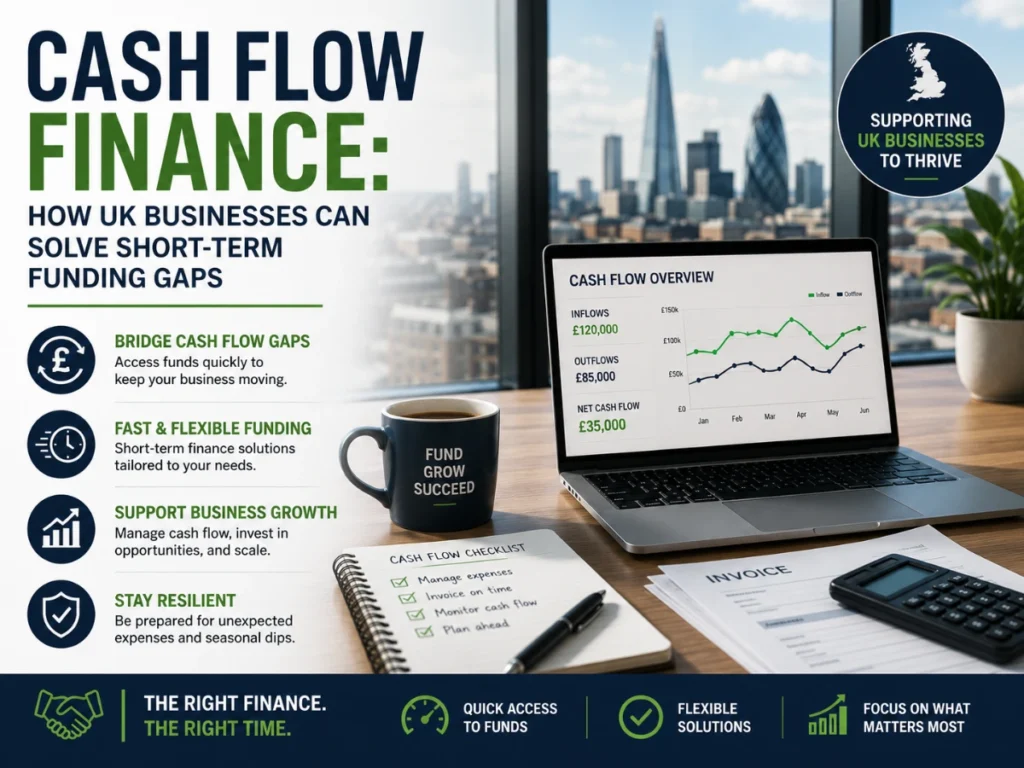
Cash flow finance is short-term funding that helps a business bridge the gap between money going out and money coming in covering payroll, supplier payments, or day-to-day costs while waiting on customer payments or seasonal income. It typically comes in the form of a working capital loan, a cash flow loan, or a revolving credit facility, and is designed to be repaid quickly once cash flow normalises. For UK businesses facing a temporary shortfall rather than a long-term problem, cash flow finance is usually faster to arrange than a traditional business loan, since lenders focus more on trading patterns than long-term projections.
Let’s look at how cash flow finance actually works, the main options available, and how to tell if it’s the right fit for your business.
What Is Cash Flow Finance?
Cash flow finance covers a category of short-term funding aimed at solving one specific problem: a business has enough revenue over time, but not enough cash on hand right now. This is common and doesn’t necessarily reflect a struggling business, a construction firm waiting on a stage payment, a retailer stocking up before a busy season, or a manufacturer covering payroll between invoice cycles can all be profitable overall while still hitting a short-term gap.
Unlike asset finance or a long-term business loan, cash flow finance isn’t tied to buying equipment or funding growth. It’s specifically about smoothing out timing mismatches between income and outgoings.
The Main Types of Cash Flow Finance
1.Working Capital Loan: A working capital loan is a lump sum used to cover general operating costs wages, rent, supplier payments, repaid over a set term, usually a few months to a couple of years. This is one of the most common forms of cash flow finance in the UK, since it’s flexible and not tied to a specific asset or invoice.
2.Cash Flow Loan / Cashflow Loan: A cash flow loan (sometimes written as cashflow loan) works similarly to a working capital loan but is often assessed specifically against a business’s cash flow patterns and bank statement history, rather than assets or credit score alone. Lenders look at how money moves in and out of the business over recent months to judge affordability.
3.Revolving Credit Facility: Rather than a one-off lump sum, a revolving facility gives a business access to funds it can draw down and repay repeatedly, similar to a business overdraft useful for recurring, short-term gaps rather than a single event.
4.Merchant Cash Advance: For businesses with regular card sales, this option advances funds against future card takings, with repayments taken as a percentage of daily sales. It suits retail and hospitality businesses with predictable transaction volumes.
Is a Working Capital Loan Right for Your Business?
Working capital loans for small businesses tend to work well when the funding gap is genuinely short-term and predictable a seasonal dip, a large order that needs stock paid for upfront, or a stretch between invoice payments. They’re less suited to covering an ongoing structural problem, where the business is consistently spending more than it earns rather than facing a timing gap.
Business working capital loans are typically assessed against monthly turnover and existing bank statement activity, so lenders want to see that repayments are realistically affordable against current cash flow not just a plan for future growth.
What Lenders Look At
Cash flow finance lenders generally focus on a slightly different set of factors than a standard business loan provider:
- Recent bank statements usually the last 3-6 months, to see the pattern of money in and out.
- Trading consistency regular, predictable cash flow is viewed more favourably than sporadic, unpredictable income.
- Existing debt obligations lenders check what else is being repaid to judge whether new funding is genuinely affordable.
- Reason for the gap being able to explain why the shortfall exists (seasonal stock, a large contract, a one-off delay) helps lenders assess risk more accurately than a vague application.
Short-Term Business Funding vs Long-Term Business Loans
It’s worth being clear on the distinction:
- short term business funding is built for gaps measured in weeks or months, not years. Repayment terms are shorter, decisions are often faster, and the underwriting focuses more on recent cash flow than long-term business plans.
- A long-term business loan, by contrast, suits growth investment hiring, expansion, or equipment where repayment is spread over a longer period against projected business performance. Using short-term cash flow finance for a genuinely long-term funding need (or vice versa) usually means paying more than necessary or taking on the wrong repayment structure.
Finding the Best Working Capital Loan for Your Business
Searching for the best working capital loans available isn’t just about the lowest rate, it’s about matching the facility to how your cash flow actually behaves. A revolving facility might suit a business with recurring seasonal gaps, while a one-off working capital loan might be better for a single, identifiable shortfall.
This is where comparing multiple lenders matters. Different providers weigh bank statement history, sector, and turnover differently, so the same business can be offered very different terms depending on who they apply to.
At FairBridge Finance, we help UK businesses compare cash flow finance options against their actual bank statements and trading patterns, rather than applying to a single lender and hoping for the best terms.
Getting the Timing Right
The most common mistake with cash flow finance isn’t choosing the wrong product, it’s applying too late. Businesses that wait until a gap has already caused missed payments or strained supplier relationships often find themselves with fewer options and higher costs. Applying early, while the business is still trading normally, generally means faster approval and better terms.
If you’re facing a funding gap and aren’t sure whether a working capital loan, cash flow loan, or a different structure fit best, FairBridge Finance can talk through your options against your specific cash flow position before the gap becomes a bigger problem.
Frequently Asked Questions
What is cash flow finance?
Cash flow finance is short-term business funding that helps cover temporary gaps between your expenses and incoming revenue. Businesses commonly use it for payroll, supplier payments, and day-to-day operating costs while waiting for customer payments or seasonal income.
What’s the difference between a working capital loan and a cash flow loan?
A working capital loan covers general day-to-day business expenses, while a cash flow loan is typically assessed using your recent bank statements and cash flow history. Although the terms are often used interchangeably, cash flow loans focus more on your short-term trading performance.
How quickly can a business get short-term funding?
Short-term business funding is usually arranged faster than a traditional business loan because lenders focus on recent trading activity instead of long-term financial forecasts. Approval times vary depending on the lender and how quickly you provide the required documentation.
Is a working capital loan suitable for a small business with irregular income?
Yes, it can be. However, lenders generally want to see that the cash flow gap is temporary and explainable, rather than an ongoing issue. They will assess whether the business can comfortably repay the loan despite fluctuating income.
What do lenders check before approving a cash flow loan?
Lenders typically review your last 3–6 months of bank statements, trading history, existing debt commitments, cash flow consistency, and the purpose of the funding to determine affordability and repayment capacity.
Is cash flow finance the same as a business loan?
No. Cash flow finance is designed as a short-term solution to bridge temporary funding gaps, whereas a traditional business loan is generally longer term and used for larger investments such as business growth, equipment purchases, or expansion projects.
FairBridge Finance is an FCA-authorised business funding broker helping UK businesses find the right cash flow finance solution for short-term funding gaps.
On this page
Related Topics
Case Studies
Read our latest articles covering commercial finance solutions, business loans, property funding, and lending insights across the UK.

Franchise Finance UK: How to Fund a New Franchise
Franchise finance UK is a category of business funding designed specifically to…


Development Exit Finance: How to Avoid a Distressed Sale
Development exit finance is a short-term loan used to repay an existing…

Limited Company Buy-to-Let: Do You Need an SPV?
Limited company buy-to-let means purchasing rental property through a Special Purpose Vehicle…